Technology Certifications
Industry-Based Requirements and Career Transitions

There have been several posts on LinkedIn and elsewhere about workforce cuts at Technology companies such as WHOOP and Lunchbox. It is therefore insightful to examine Technology positions in various sectors. One way to transition into another sector is to earn a Technology credential applicable to that particular sector. In this issue we will examine Technology Certifications in various industries.
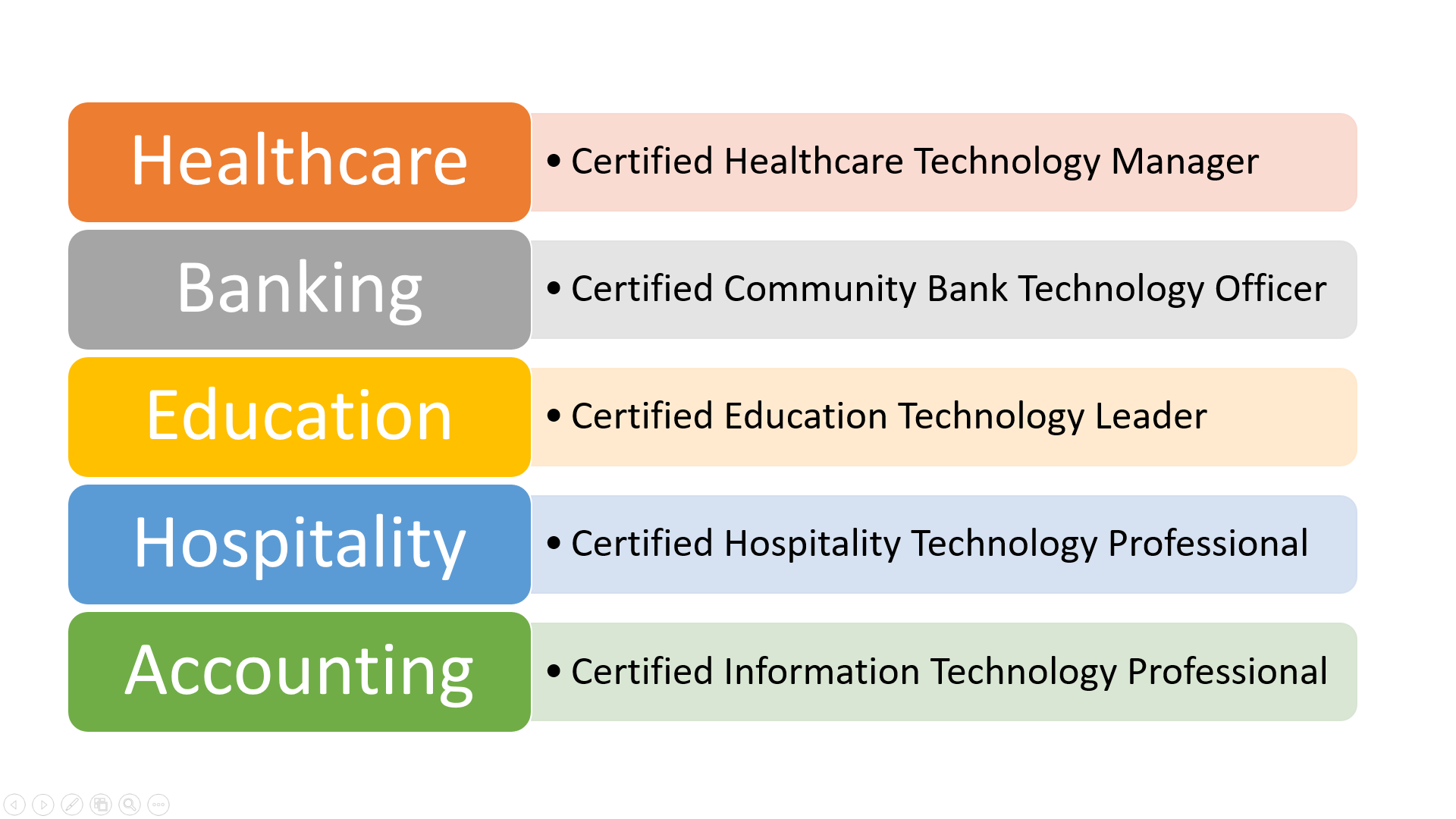
Let’s start with healthcare. The Certified Healthcare Technology Manager credential sponsored by the Association for the Advancement of Medical Instrumentation helps Technology Professionals demonstrate competence in Healthcare Technology. The certification covers two major areas: management of health technology operations and management of personnel. To be eligible for the Program a candidate needs seven years of work experience in biomedical technology or related healthcare disciplines or information technology or business management. Three of the seven years must include supervisory experience. If a candidate completes the Department of Defense’s biomedical equipment maintenance technician (DOD BMET) training program, only three years of supervisory work experience is required. Those who have earned the Certified Biomedical Equipment Technician (CBET) are also eligible.
Let’s examine Banking next. The Certified Community Bank Technology Officer (CCBTO) sponsored by the Independent Community Bankers of America prepares candidates for careers in Information Technology at Banks. Candidates must complete a weeklong training program covering a multitude of topics such as Cybersecurity Risk, Budgeting for IT, Cloud and Deployment Trends, Technology Asset Management, Cyber Attack Lifestyle & Attack Vectors and Cyber Incident Responses. Candidates receive a complete complimentary online course upon registration for advanced preparation. The Independent Community Bankers of America also makes available a multitude of live and on-demand webinars for candidates.
For those looking for a professional development tool in Learning Technologies, the Certified Education Technology Leader (CETL) credential is an appropriate solution. This program blends technical knowledge with the understanding of the educational environment, leadership, vision, and the management of technology and support resources needed to integrate technology across the curriculum to advance student outcomes. Candidates must have must have at least seven years of demonstrable experience in education technology to apply for the program. Facilitated virtual courses and self-study courses are available to prepare for the exam, Topics include Instructional Focus & Professional Development, Information Technology Management, Communication Systems Management and Data Privacy and Security among others.
For those in Hospitality, there is the Certified Hospitality Technology Professional (CHTP). This program is sponsored by the organization, Hospitality Financial and Technology Professionals. To earn the designation candidates must pass the CHTP exam. The exam covers three areas: Hospitality Applications, Hospitality Technology Management and Core Technology. The Hospitality Applications section covers topics such as Marketing, Entertainment, Property Management, Revenue Management, Inventory Management and Financial Management. The Hospitality Technology Management section covers topics such as Disaster Recovery, Budgeting, Vendor Management and Forecasting. The Core Technology section covers topics such as Networking Concepts, Communications. Server Management, Computer Hardware and Operating Systems among others.
For those in accounting there is the Certified Information Technology Professional (CITP). The Certified Information Technology Professional specializes in the intersection of technology and financial reporting. A Certified Public Accountant who has the unique ability to develop business insights by leveraging knowledge of information relationships and supporting technologies is awarded the Certified Information Technology Professional. Candidates must pass an exam to earn the credential.
Technology professionals can broaden their set of opportunities by earning similar credentials in other industries.